
Chapter 01 Peripheral Sense
Peripheral Sense: At the Threshold of Touch
At the Threshold of Touch
At the threshold of touch, perception begins before contact.
Peripheral Sense explores how sensing emerges at the edges—where light meets air, where material responds to movement, and where awareness is activated without direct interaction. Rather than centering vision or touch, these lamps operate through proximity, rhythm, and hesitation, inviting the body to notice what is usually overlooked.
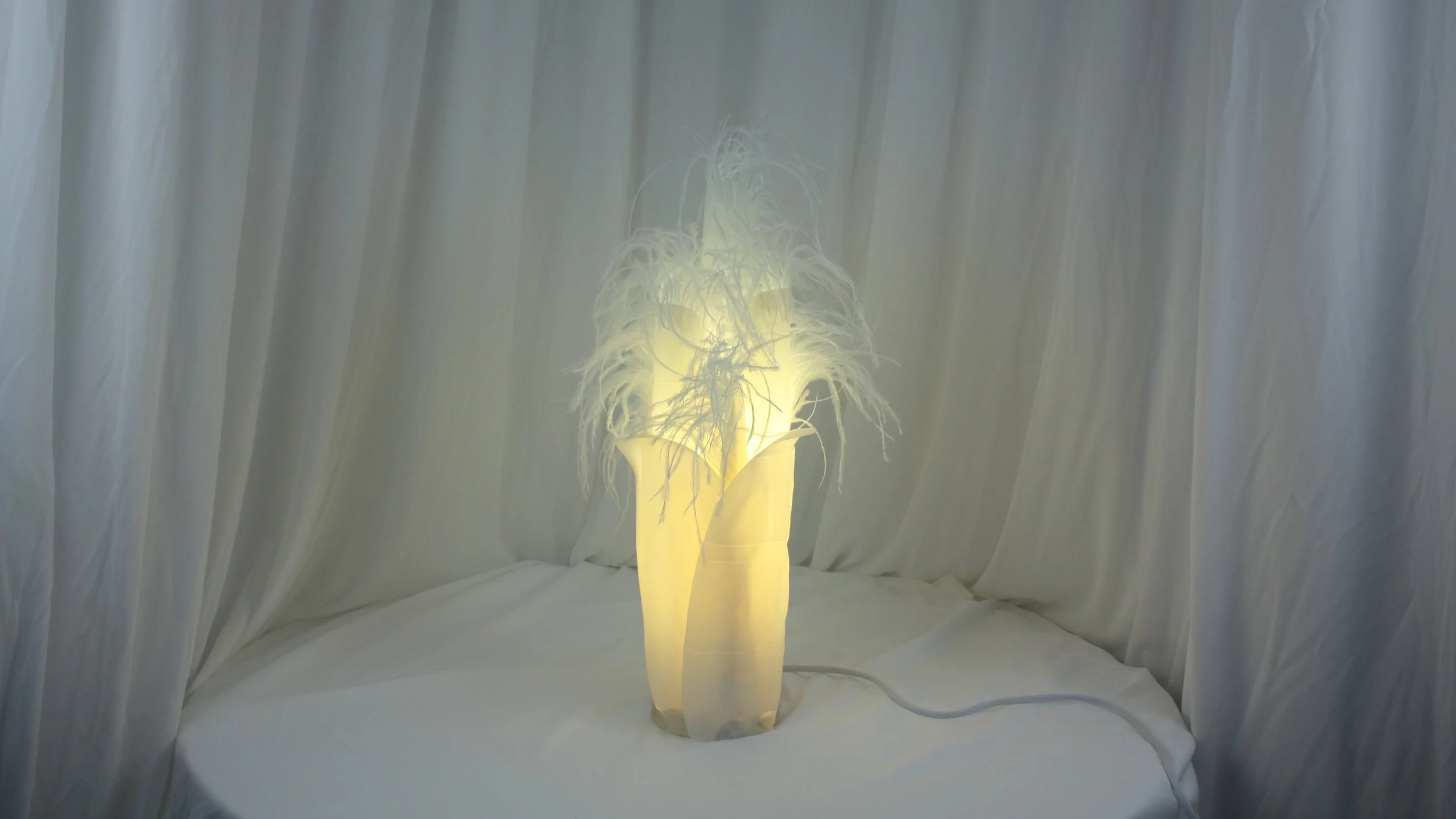
Peripheral Sense I
This lamp is composed of six vertical elements arranged in a steady alternation of height—three tall, three short—forming a balanced and measured rhythm. The structure establishes a calm order, while the feathered perimeter softens its boundaries. Light diffuses outward rather than upward, grazing the feathers as air circulates around them.
Here, perception is stabilized through repetition and symmetry. The lamp does not perform; it waits. Sensitivity arises through stillness, through the gentle movement that occurs when the surrounding environment quietly intervenes.

Peripheral Sense II
In contrast, this lamp unfolds through a downward spiral. Six vertical elements descend in gradual reduction, forming a continuous movement rather than a fixed pattern. The structure suggests flow instead of balance, and progression instead of repetition. Light follows this spiral path, creating a sense of temporal unfolding.
Here, perception becomes directional. Sensitivity is no longer evenly distributed but accumulates through movement, inviting the eye and the body to follow a slow, descending trace toward the periphery.
Together, the two lamps form a shared field of peripheral sensing—one grounded in equilibrium, the other in motion. Between them, perception oscillates, reminding us that sensitivity does not reside at the center, but emerges quietly at the margins of attention.